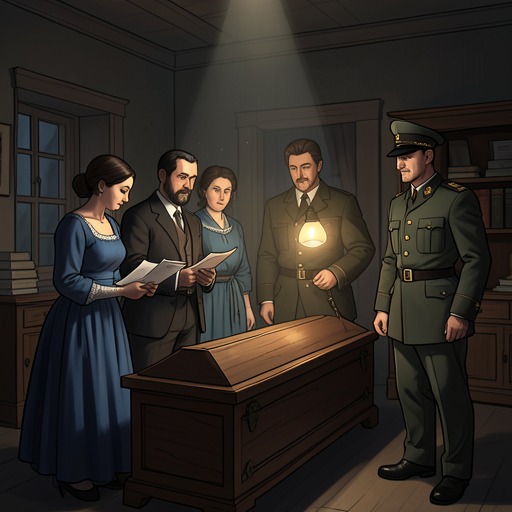
Pelagia Nilovna Tiagunova
Doctor ZhivagoPelagia Nilovna Tiagunova is the devoted companion who volunteers to follow Prituliev into forced transport, then becomes one of the mysterious figures in the labor conscripts’ escape. Her attachment to him persists through separation, danger, and an unexplained disappearance; when she is next seen with Vasia, she is silent and fearful, and he must persuade her to move toward safety.
Identity and Background
The narrative introduces Pelagia as a woman living with Prokhor Kharitonovich Prituliev in Petrograd. At the time he was arrested, he had just said goodbye to her before setting out to keep an appointment. Looking down Liteiny Street, he could still see her back vanishing into the crowd. The brief image establishes their separation at the moment his ordinary life gives way to arrest and forced movement.
Pelagia is described as plump, with a stately carriage, beautiful hands, and a thick braid that she tosses over her shoulder. She joins the convoy voluntarily to accompany Prituliev. Her presence is therefore not incidental: she chooses to follow a man who has been taken from his previous life and placed among labor conscripts under armed guard.
Attachment to Prituliev and Rivalry
Prituliev’s circumstances are defined by the contrast between his unremarkable appearance and the loyalty he inspires. The narration remarks that it is hard to understand what attracts women to such an ugly man, yet says that women cling to him. Pelagia is one of two women who make their way onto the train because of their connection to him.
The other is Ogryzkova, a bony young woman with white eyelashes who has somehow joined the train as well. Pelagia calls her insulting names, including “the squirt” and “the nozzle,” and the two rivals are described as being at swords’ points. They avoid one another’s cars, leaving it unclear how Ogryzkova finds opportunities to see Prituliev. The rivalry gives Pelagia’s loyalty a social setting: her attachment is not only a private bond but also a contest played out within the cramped, guarded convoy.
Escape and Disappearance
The train carries labor conscripts under the guard of Private Voroniuk. Among the other prisoners are Prituliev, a former government liquor-store cashier; Vasia Brykin, a sixteen-year-old apprentice; and Kostoied-Amursky, a gray-haired revolutionary who has endured forced-labor camps under both the old and new regimes. Pelagia and Ogryzkova are present alongside the men, though their movements between the cars remain unclear.
By the next morning, Antonina Alexandrovna reports that Prituliev and Vasia have escaped, as have Pelagia, Ogryzkova, and Voroniuk. The precise sequence is unknown, and nobody can say whether the women left freely or whether one of them had been killed. Antonina speculates that Pelagia might have killed Ogryzkova, or Ogryzkova Pelagia, but presents both possibilities as unresolved conjecture. The narrative does not confirm either woman’s role in the other’s disappearance. Voroniuk, meanwhile, has also fled, apparently after discovering that the prisoners were gone; the resulting confusion provokes a dispute between the escort commander and the officer responsible for moving replacements to the front.
The escape is thus first experienced through uncertainty. Even the officials cannot establish who left together or in what order, and the women’s rivalry makes suspicion easy without supplying proof. The later appearance of Pelagia with Vasia resolves her own disappearance, but not the question of what happened between her and Ogryzkova.
With Vasia After the Escape
Pelagia is next encountered with Vasia in the wilderness. He addresses her as Auntie Polia and urges her to leave their hiding place for a village, where he believes people will shelter them. They have gone two days without food, and he warns that continuing as they are may lead to starvation. He also reasons that Voroniuk must have raised an alarm and that people will be searching for them.
Vasia’s account of the escape offers a possible explanation for Pelagia’s distress, but does not settle what happened to Ogryzkova. He insists that Pelagia did not mean to push Ogryzkova off the train, says that he saw Ogryzkova get up and run away, and expects her and Prituliev to catch up with them. This is Vasia speaking to reassure Pelagia, not an independent confirmation of the whole sequence. His confidence contrasts with the uncertainty surrounding the escape as reported by Antonina.
Pelagia has said nothing for two days and is so preoccupied that Vasia repeatedly asks what frightens and saddens her. Yet his concern is practical as well as consoling: they need food, shelter, and movement before the searchers find them. After his encouragement, Pelagia gets up, takes his hand, and quietly agrees to go, calling him “lamb.” The small exchange gives her the scene’s decisive action: after a period of silence and immobility, she accepts Vasia’s help and resumes moving through the danger of the escape.
Narrative Role
Pelagia’s appearance links the crowded world of forced transport to the uncertain journey that follows the prisoners’ flight. Her voluntary presence on the convoy demonstrates the strength of her attachment to Prituliev, while the rivalry with Ogryzkova makes her disappearance a source of suspicion. The book withholds a definitive account of that disappearance, allowing the reader to feel the same uncertainty that surrounds the escape itself.
Her later scene with Vasia shifts attention from the mystery to its human consequences: hunger, fear, silence, and the need to choose whether to keep hiding or seek shelter. Pelagia is not given a long account of her own thoughts or history. Instead, her change is conveyed through a spare action—she takes Vasia’s hand and agrees to go—while the unresolved fate of Ogryzkova remains outside the certainty of the scene.